Introduction
Choosing a bow
Despite what is obviously a subjective, personal issue, selecting a bow can and should remain a rational process. It is easy enough to say, "just try bows until you find ones you like." Yes, but how do you know what to like? 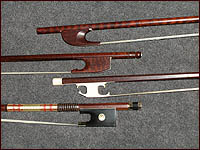 For many of us who are deeply involved in early music performance, it has become clear that the two-hundred fifty years before 1800 presents many stylistic challenges. There is continuous change, (decade by decade,) as well as national variations. The ideal must always bow to the practical in that most of us can only afford to own one or two primary instruments, and at most, three or four bows. For the professional early music violinist -- a short sonata bow, a long sonata bow, and a "transitional" (early modern) bow are the minimum requirements. Within this range are Italian, French, and English examples, each of which has unique characteristics. The violone (bass) or viol player will have a similar choice. My suggestion simply is, try bows, as many of them by different makers as you can. But do so wisely. Have a basic background in the history and development of bows.
The best introduction is Robert Seletsky's article in The Revised New Grove, (Bow-c1625-c1800.) This is the best recent scholarship, and will be a surprise to many, especially those who offer bows with screw mechanisms claiming they are early or middle 18th century models. I encourage the use of both short and long sonata bows with fixed or "clip-in" frogs. It is clear that these were the norm until very late in the century; almost all screw mechanism bows that survive are either rebuilt earlier examples or bows made after 1740---in other words, really what are sometimes called "transitional" or "classical" bows. In this regard, there is an additional practical consideration, especially for those living in North America where the humidity can vary so dramatically: An historically accurate clip-in bow requires some patience and preparation. I and others usually sell them with two frogs to vary the hair tension, but this is often not enough. It is good to have a small piece of leather or card stock to slip under the hair for the most humid days. It does not take long to get used to this added preparation. Of course for many this is an unreasonable burden, and it is surely not a moral issue. As was done in the later 18th century, I will construct some earlier models with a hidden screw mechanism modifying some elements of design to retain the best playing characteristics. To this end I use a very light and strong titanium screw to keep the balance and weight correct.
*Robert Seletsky has recently completed a greatly expanded article on the early bow, printed in two parts in Early Music Magazine, in 2004. Again, this represents the latest scholarship. Dr. Seletsky and I have discussed many of the facts and conclusions newly presented here.
Another common distraction when trying bows, that I have observed sometimes, is a sort of fixation on one particular bow. I have had customers who are very fine players so enamoured of one bow, owned by another person, that they seem unable to find any bow that will satisfy them. Of course there are no "replicators" or bow cloning techniques, and every piece of wood varies, as does the working of it. I do understand obsession, but don't recommend it. I would suggest the following: Either,
1. Try bows of a completely different model, appropriate to the music, or from a different maker, to find a new ideal.
2. Be open to the positive aspects of difference, acknowledging that there may be more than one ideal bow in this non-platonic, best of all possible worlds.
These suggestions are not meant to imply that all bows are equal; certain characteristics of a bow may represent serious flaws. I have on several occasions played happily on a certain bow, only to sell it to a desperate individual and make another of the same model for myself. Well, of course, the new bow is not the same, but barring any real design flaw, I normally find that I enjoy the differences, my playing actually adapts to the new bow, allowing new variety to my playing.
I have only a few words of discouragement. I advise against buying a generic bow, one which is not based on some original. My view is that the purpose of exploring early techniques and equipment is to learn and discover, to appreciate the music in a new old way, not to rewrite history. Avoid "Piltdown" bows. This is not to say that all bows must 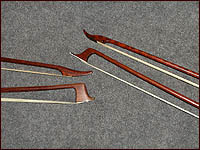 be "bench copies," only that where there are surviving examples---and often several by the same maker---it makes sense to me to look at the range of variation within the work and materials and find necessary freedom therein. There are many fine craft-persons who work from old historical examples. Their research and effort are there for you. An exception is baroque bows for the 'cello. Examples before 1770 are almost unknown, therefore extrapolation from existing later bows and from violin, viola and gamba bow models and iconography is necessary.
The preceding is intended for those with a deep interest in historical performance practice, but not everyone is so inclined. Good music is, of course, for everyone. I do believe that a performer on a modern violin, viola or 'cello can learn a lot and grow in appreciation for music before 1800 by working with an early model bow. There are several models which function well on the modern instrument, with or without gut strings, and are a very good choice. Just ask. A bow, well made and well chosen, can add immeasurably to a happy musical experience, and in addition, is always a good investment.
Finally, please feel free to contact me for further information. After an initial e-mail, I will be happy to discuss any and all issues. I am open to any serious inquiry, by phone or otherwise, and have always been quite happy to recommend other bow makers to any musician, when appropriate.